by Sebastien Goulard
Following attacks carried out by the Houthis and Iran against oil infrastructure in Saudi Arabia, President Emmanuel Macron announced on September 24 that France would soon send military personnel and defence equipment (including radars and surface-to-air missiles) to Saudi Arabia to strengthen the protection of the port city of Yanbu on the Red Sea.
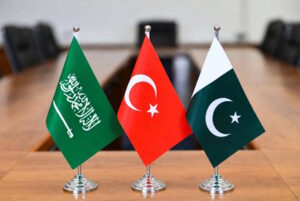
France is not the only European country participating in the defence of Saudi infrastructure. Paris has thus joined London and Rome. Riyadh, for its part, is seeking to diversify its partnerships amid the crisis facing the kingdom, in order to avoid relying on the United States, whose involvement could be reconsidered by Donald Trump. It is in this context that the signing of the joint defence agreement in Mecca between Saudi Arabia, Türkiye and Pakistan should also be considered.
For Paris, relations with Riyadh are strategic from both an economic and political perspective. While France has been cooperating with Saudi Arabia since the beginning of the conflict, Emmanuel Macron’s statement aims to formalise this partnership. Since 2009, France and the United Arab Emirates have been bound by a defence agreement committing both parties to mutual protection. It was under this agreement that French military personnel stationed in the UAE intercepted Iranian missiles over their partner’s territory in March 2026. The security of the UAE and Saudi Arabia is considered a priority for France’s strategy in the Middle East.
There is, however, no consensus among French political parties on this military initiative. La France Insoumise and the Rassemblement National, at opposite ends of the political spectrum, have stated their opposition to a French military presence in Saudi Arabia. France, like the rest of Europe, is also facing a significant increase in fuel prices, with major social and economic consequences.
This French military presence in Saudi Arabia also demonstrates Paris’s interest in IMEC. The security of Saudi infrastructure is essential to ensuring commercial exchanges between Europe, the Middle East and the Indian subcontinent, as well as supplying Europe with Saudi oil since the blockade of the Strait of Hormuz. The port of Yanbu is the terminal of the East-West pipeline, which was hit by a drone attack on September 10. It is once again operational.
For IMEC to function, it requires security. It is clear that the European side is prepared to engage in the defence of Saudi Arabia.