by Sebastien Goulard
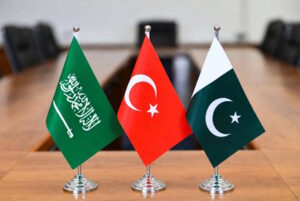
In an interview with NDTV on July 2, 2026, Hervé Delphin, the EU Ambassador to India, described the IMEEC as “a network of networks.” This means that the corridor should not be understood as a single route linking India to Europe. His statement also responds to recent questions regarding Israel’s role within the IMEEC. Some experts argue that Saudi Arabia may favor a Syrian route bypassing Israel while coordinating with Ankara to revive the Hejaz Railway. Indeed, the resurgence of the Israeli–Palestinian conflict following Hamas’s attacks on October 7, 2023, has weakened the prospects for renewed cooperation between Saudi Arabia and Israel. At the same time, Türkiye has long viewed the IMEEC project with caution, fearing that it could undermine the Trans-Caspian Corridor.
Syria’s economic reopening is attracting new foreign investors, as illustrated by the recent visit of the French President. Among these investors, Gulf companies, -particularly from the United Arab Emirates-, are seeking to participate in the country’s reconstruction and develop new infrastructure. In this context, it is only natural that Saudi Arabia and the UAE would seek to integrate Syria into the IMEEC, especially given Damascus’s strong commitment to the initiative. This does not, however, imply that Israel would be excluded from the corridor. To operate at its full potential, the IMEEC should not be viewed as a single linear route but rather as a network, as Hervé Delphin emphasized.
The construction of new infrastructure is a key component of the IMEEC’s implementation, but the corridor represents far more than a transport project. It is a process of regional integration encompassing energy, industry, and innovation. As the EU Ambassador to India pointed out, it is “a project for the long haul.”
During the interview, Hervé Delphin also stressed that tensions in the Middle East, – particularly the crisis surrounding the Strait of Hormuz -, vindicate the necessity of such a corridor.
The European Union and India should continue to support dialogue initiatives across the Middle East in order to accelerate the implementation of the IMEEC.